Key Takeaways
- A Roth conversion strategy for Maryland residents moves pre-tax IRA or 401(k) balances into a Roth IRA, triggers federal and Maryland income tax in the year of conversion, and allows qualified future distributions to come out federally income tax-free.
- Under current federal law after SECURE 2.0, required minimum distributions begin at age 73 for individuals born 1951 through 1959, and at age 75 for those born in 1960 or later.
- Maryland state income tax rates run up to 6.50% at the top bracket added in 2025, and Maryland county rates add another 2.25% to 3.20%, so combined federal, state, and county rates on a converted dollar can approach or exceed 30%.
- The Maryland Pension Exclusion ($40,600 for 2026) applies only to distributions from qualified employer plans, not to IRA distributions or Roth conversion amounts.
- Each Roth conversion has its own 5-year clock before the converted principal can be withdrawn penalty-free by an owner under age 59½.
- Roth conversions can be executed at any age, but once RMDs have begun, the required distribution must be taken first, and the RMD itself cannot be converted.
Roth conversion strategy for Marylanders age 50 and up
A Maryland couple in their late 60s meets with a planner to review their retirement picture. They have $1.4 million split across a traditional IRA and a rollover 401(k). Neither has taken a required minimum distribution yet. The question they arrive with is not whether to do a Roth conversion, but whether they missed the window entirely.
The answer to a Roth conversion question generally depends on which phase of retirement the household is in, what their combined federal and Maryland tax bracket looks like today, and what it is likely to look like over the next 10 to 20 years.
A Roth conversion strategy for Maryland residents age 50 and up is a tax planning decision, not a product. Whether you are 55 and still working, 68 and drawing from savings, or 76 and taking required minimum distributions, the core question is the same. Does it make sense to pay federal and Maryland income tax now on a portion of your traditional retirement balances, so the money can grow and come out federally income tax-free later?
Roth conversion planning in Maryland involves federal tax brackets, Maryland state income tax up to 6.50%, Maryland county income tax up to 3.20%, IRMAA thresholds if you are on Medicare, and the Maryland Pension Exclusion for those age 65 or older. For households looking to reduce taxes in retirement, Marylanders often review Roth conversions as part of a broader tax-aware retirement planning approach, alongside required minimum distributions planning, Social Security timing, and a tax-efficient retirement withdrawal strategy across account types. To see how a coordinated review fits your situation, visit our retirement income planning service page.
What is a Roth conversion?
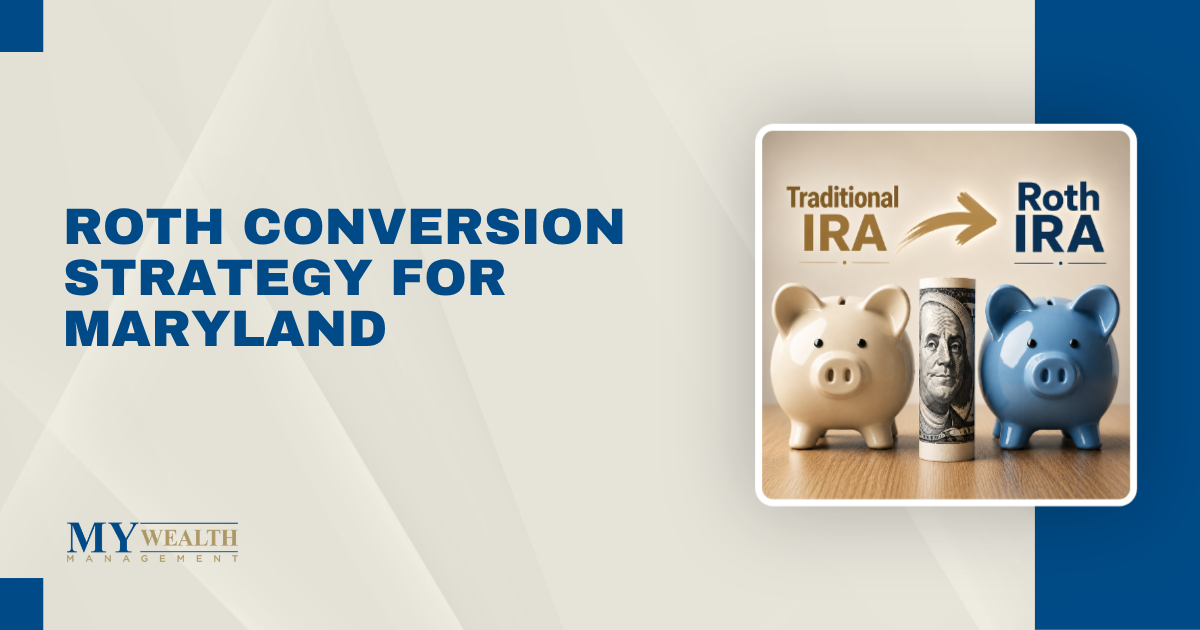
A Roth conversion moves money from a traditional IRA or pre-tax 401(k) into a Roth IRA. You pay federal and Maryland income tax on the converted amount in the year of the conversion, and under current federal law, qualified future distributions from the Roth IRA come out federally income tax-free. Roth IRAs are not subject to required minimum distributions during the original owner's lifetime.
A Roth conversion is not a way to avoid income tax. It is a way to pay income tax earlier, based on the planning assumption that your current combined federal and state rate may be lower than a future rate. That is a planning assumption, not a fact. Tax laws, tax brackets, and IRMAA thresholds are subject to change, and outcomes vary by individual circumstances.
For Maryland residents, national Roth conversion calculators may not include Maryland state and county tax. When they do not, the calculator can understate the true cost of a conversion for Maryland households, since state and county rates can add 4% or more on top of the federal rate. For a fuller review of Maryland retirement tax rules, our retiring in Maryland tax guide covers state brackets, the Pension Exclusion, and withdrawal planning.
Three phases of Roth conversion planning
At age 50 and up, the Roth conversion question shows up in three distinct phases of retirement. The Working Years cover ages 50 through the last day of employment income. The Bridge Years cover retirement through the year before required minimum distributions begin. The Distribution Years cover the years after RMDs have started. The planning logic is similar across phases; the mechanics and trade-offs differ.
The Working Years: age 50 through retirement
If you are age 50 or older and still working, W-2 income tends to place you in a higher combined federal and Maryland bracket than you may be in after retirement. Large Roth conversions during peak earning years are typically more expensive on a per-dollar basis than the same conversions after employment income ends. That does not mean nothing is worth doing in the Working Years.
Roth 401(k) contributions. If your employer plan offers a Roth 401(k) option, contributions can be made with after-tax dollars during working years. Under SECURE 2.0, designated Roth 401(k) accounts are no longer subject to lifetime required minimum distributions effective 2024, which aligns them with Roth IRA treatment.
Backdoor Roth contributions. For Marylanders whose income exceeds the direct Roth IRA contribution limits, a backdoor Roth involves making a nondeductible traditional IRA contribution and then converting it to a Roth IRA. This works cleanly only when the household has no other pre-tax traditional IRA balances. If pre-tax IRA money exists, the IRS pro-rata rule under IRC Section 408(d)(2) treats all traditional IRA balances as one and taxes the conversion proportionally between pre-tax and after-tax dollars. Rolling pre-tax IRA balances into a workplace 401(k) plan, if the plan accepts rollovers, can sometimes clear the way for a clean backdoor Roth.
Mega backdoor Roth contributions. Some 401(k) plans allow after-tax contributions beyond the regular deferral limit and permit in-plan Roth conversions or in-service rollovers to a Roth IRA. Whether this is available depends on the specific plan document.
Gap-year conversions. A year with substantially lower income, whether from a job change, sabbatical, or deductible business loss, can create a temporary bracket window suitable for a one-time Roth conversion during the Working Years.
The 5-year rule for conversions. Each Roth conversion starts its own 5-year clock. Converted principal is generally available for withdrawal without the 10% early distribution penalty after five tax years from the conversion, or after the account owner reaches age 59½, whichever comes first. For Marylanders converting in their 50s, this matters if there is any chance of touching converted principal before age 59½. Growth on converted amounts follows different rules and may be subject to tax and penalty if withdrawn before qualified conditions are met.
The Bridge Years: retirement to the RMD start date
The Bridge Years are the stretch between the end of employment income and the start of required minimum distributions. Under current federal law after the SECURE 2.0 Act, RMDs from traditional retirement accounts begin at age 73 for individuals born between 1951 and 1959, and at age 75 for those born in 1960 or later. Verify current RMD rules with the IRS Retirement Topics on RMDs.
The Bridge Years are the phase with the widest planning flexibility for Roth conversions because taxable income is often more discretionary. W-2 income has stopped and required distributions have not yet started. If Social Security is delayed until age 70, the years between retirement and the first benefit check can carry lower brackets than either the working years or the years after benefits begin.
Every dollar converted during the Bridge Years is taxed at the current-year federal, Maryland, and county rate. Whether the current rate is lower than the future rate depends on future income, future tax law, and future IRMAA thresholds, factors that cannot be known in advance.
Marylanders born in 1960 or later have a longer Bridge Years window than earlier cohorts, since RMDs for that group begin at age 75 rather than 73. That additional planning time can be relevant to how conversions are sized and sequenced.
The Distribution Years: age 73 or 75 and up
Roth conversions remain available under current federal law after RMDs have begun. Three mechanics are worth knowing.
RMDs come first. Once you have reached your RMD age, the required distribution for the year must be taken before any additional amount can be converted to a Roth IRA. The RMD amount itself cannot be converted. Any Roth conversion in a post-RMD year is on top of, not in place of, the RMD.
Roth 401(k) distinction. Effective 2024 under SECURE 2.0, designated Roth 401(k) accounts are no longer subject to pre-death required minimum distributions. Marylanders who kept Roth 401(k) balances in an employer plan may no longer need to roll them to a Roth IRA solely to avoid RMDs, though other planning reasons for consolidation may still apply.
Different motivations. Conversion motivations in the Distribution Years are often different than in earlier phases. Rather than reducing the account owner's own future tax bill, Distribution Years conversions are frequently oriented toward reducing the surviving spouse's future tax bracket, reducing the 10-year distribution tax burden for non-spouse heirs under the SECURE Act, or coordinating with qualified charitable distributions. For related planning on inherited retirement accounts, see our guide to what to do after inheriting assets in Maryland.
How Maryland state and county taxes affect Roth conversions
Maryland taxes Roth conversions as ordinary income in the year of conversion. Federal tax is only part of the calculation. Under current law, Maryland state income tax rates run from 2% at the lowest bracket to 6.50% at the top bracket, which was added in 2025 for higher-income filers along with a new 6.25% bracket. Maryland county income taxes add another 2.25% to 3.20% depending on your county of residence, with rates varying across Montgomery, Howard, Frederick, Baltimore, Anne Arundel, Prince George's, Carroll, Harford, and the rest of the state. Verify current state and county rates with the Maryland Comptroller, as rates and brackets are subject to change.
Combined, a conversion taxed at 22% federally can carry a combined federal, state, and county rate approaching 30%, and higher for filers who reach the upper Maryland brackets. This does not make Roth conversions unsuitable for Maryland residents. It means the sizing of conversions is a Maryland-specific calculation rather than a national rule of thumb, and the appropriate amount depends on your household's specific circumstances.
Maryland Pension Exclusion Note
Once you reach age 65, eligible pension and annuity income may qualify for the Maryland Pension Exclusion. The maximum exclusion was $41,200 for the 2025 tax year and $40,600 for the 2026 tax year. Eligibility requires being at least 65 years old, totally disabled, or having a totally disabled spouse. The exclusion applies to distributions from qualified employer retirement plans, meaning 401(k), 403(b), 457(b), and defined benefit pension plans. It does not apply to traditional IRA distributions or to Roth conversion amounts. The exclusion is reduced dollar-for-dollar by Social Security or Railroad Retirement benefits received in the same year. Verify current exclusion amounts and eligibility rules with the Maryland Comptroller.
Not sure if a Roth conversion fits your plan?
Our free three-step retirement evaluation reviews your investments, uncovers tax planning opportunities, and helps assess your retirement income, so you can see how the pieces fit together.
Start Your Free Retirement EvaluationHow IRMAA affects Roth conversion planning
IRMAA raises Medicare Part B and Part D premiums when a household's modified adjusted gross income from two years earlier exceeds certain thresholds. Roth conversions raise MAGI in the conversion year, which can raise Medicare premiums two years later.
IRMAA thresholds are structured as tiers. Crossing a threshold by any amount can trigger the full surcharge for that tier, rather than a gradual increase. IRMAA planning is relevant during the Bridge Years for retirees on Medicare or within two years of enrolling, and during the Distribution Years where RMDs already occupy a share of the annual bracket. Verify current thresholds with the Social Security Administration or the Centers for Medicare and Medicaid Services.
Coordinated Roth conversion planning generally accounts for IRMAA thresholds alongside federal and Maryland bracket sizing. Our companion article, the IRMAA surcharges guide for Maryland retirees, covers the current brackets in more detail. IRMAA brackets and rules are subject to change.
The surviving spouse tax cliff and Roth conversion planning
For married Marylanders, one Roth conversion motivation shows up specifically at older ages. The surviving spouse tax cliff is the tax bracket increase that happens when one spouse passes away and the survivor begins filing as a single taxpayer.
When one spouse dies, the surviving spouse typically files as single starting the year after the death rather than married filing jointly. The single-filer federal tax brackets are narrower than the joint brackets. The same taxable income that fell in the 22% bracket on a joint return may fall in the 24% or 32% bracket for the survivor. The Maryland Pension Exclusion also cannot continue to be claimed against both spouses' incomes once one spouse has passed.
Roth conversions completed while both spouses are living can reduce the traditional balances that would otherwise generate taxable RMDs for the survivor at single-filer rates. Whether the surviving spouse cliff is a meaningful factor for a given household depends on ages, health, income sources, and other planning factors specific to the household.
How a Roth conversion ladder works
A Roth conversion ladder is a strategy of spreading conversions across multiple years rather than converting a large balance in a single year. Annual conversion amounts are typically sized to fill a target federal bracket without crossing into the next bracket, and to stay below a targeted IRMAA tier. This helps manage bracket exposure for Maryland residents, because state and county income taxes compound the federal cost.
Bridge Years Illustration
A Maryland couple born in 1962 retires at age 63 and delays Social Security until age 70. Under current federal law, their required minimum distributions begin at age 75 because they were born after 1959. Beginning at age 64 and continuing through age 74, they consider annual conversions sized to fill a target federal bracket without crossing into the next tier, while monitoring IRMAA thresholds. By the time RMDs begin, a portion of the traditional IRA balance has already been converted, which changes the size of the resulting RMDs.
Illustrative example only; not a recommendation, projection, or guarantee of any specific outcome.
Distribution Years Illustration
A Maryland couple both age 78 has traditional IRA balances that generate a combined required minimum distribution of $95,000 for the year. Their target federal bracket has room for another $40,000 of taxable income before the next bracket and next IRMAA tier. They consider a $40,000 Roth conversion on top of the RMD, aimed at reducing the future taxable RMD stream and the traditional balance that would eventually pass to non-spouse heirs under the SECURE Act 10-year rule. Whether this approach fits the household depends on their combined state and county tax picture, IRMAA planning, estate goals, and other individual factors. Actual outcomes will differ.
Illustrative example only; not a recommendation, projection, or guarantee of any specific outcome.
When a Roth conversion may not be the right move
A Roth conversion may not fit a household's situation when the current combined federal and Maryland tax rate is likely higher than the projected future rate, when there are not enough funds outside retirement accounts to pay the conversion tax, or when charitable giving or medical deductions are expected to substantially offset future retirement income.
The current bracket is higher than the projected future bracket. A Maryland household in a peak-earning year at the top of the 32% or 35% federal bracket, whose projected retirement bracket is 22% or 24%, is generally paying a premium to convert now. Waiting until income drops may cost less.
No funds outside retirement accounts to pay the tax. Paying the conversion tax from the IRA itself reduces the amount that reaches the Roth. For account owners under 59½, the withheld portion may also create an early-distribution penalty. Absent outside cash to cover the tax, the math often does not work.
Large charitable bequests are planned. Traditional IRA balances pass to qualified charities free of income tax at death. A household planning to leave a substantial portion of traditional retirement balances to charity may not benefit from converting those dollars first, since the charitable recipient would not have owed the tax anyway.
High medical or long-term care deductions are expected. Households anticipating large itemized medical or long-term care deductions in later retirement years may find that those deductions naturally offset traditional RMD income, reducing the marginal value of converting today.
A move to a no-income-tax state is planned within a few years. Converting while a Maryland resident locks in Maryland state and county tax on the converted amount. Waiting until residency changes to Florida, Delaware, Texas, or another lower-tax jurisdiction can materially reduce the total tax cost of a future conversion.
Whether any of these situations applies to your household depends on facts specific to you, and the picture can change over time. Consult a qualified tax professional regarding your specific situation.
Seven Roth conversion planning oversights
Converting into a higher bracket than intended
Converting an amount that pushes taxable income into a higher federal bracket, or across an IRMAA threshold, can reduce or eliminate the intended tax benefit. Bracket sizing is part of the planning design.
Paying the conversion tax from the IRA itself
This reduces the amount that ends up in the Roth. If you are under age 59½, the withheld portion may also be treated as a distribution and subject to additional tax. Paying the tax from outside funds is often preferred where feasible.
Missing the RMD-first rule once distributions have begun
In the Distribution Years, the required distribution for the year must be taken before any additional amount can be converted. The RMD itself cannot be converted to a Roth IRA. Any conversion that year is on top of the RMD and adds to taxable income beyond it.
Overlooking Social Security taxation
A Roth conversion raises provisional income, which can increase the federally taxable portion of Social Security benefits in the conversion year. This interaction affects the true after-tax cost of a conversion.
Overlooking the Maryland Pension Exclusion effect of a 401(k) rollover
The Maryland Pension Exclusion applies to distributions from qualified employer plans but not to IRA distributions. Rolling a 401(k) balance into a traditional IRA to simplify Roth conversion planning eliminates Pension Exclusion eligibility on that money going forward. Whether the tradeoff is worthwhile for a Maryland resident age 65 or older depends on Social Security benefit level, projected retirement income, and other planning factors.
Overlooking state residency planning
If a household plans to change state residency within a few years, the state and county tax component of the conversion math changes. Whether to convert while a Maryland resident, wait until residency changes, or split conversions across the move depends on facts specific to the household.
Treating it as a single-year decision
Roth conversion planning is typically a multi-year process. Income, markets, tax laws, and personal circumstances change over time, and prior years' assumptions may not hold in later years.
Considering a Roth Conversion in Maryland?
A Roth conversion can reshape your tax picture for years to come. Our free retirement evaluation reviews your investments, tax planning opportunities, and helps assess your retirement income so you can move forward with a clearer plan.
Start Your Free Retirement EvaluationReferences
Sources and Further Reading
The rules discussed in this article come from the following authoritative sources. Figures and rules are subject to change; verify current information before making planning decisions.
- IRS Publication 590-A: Contributions to Individual Retirement Arrangements. Federal rules for traditional IRA contributions, Roth contribution limits, and conversion mechanics.
- IRS Publication 590-B: Distributions from Individual Retirement Arrangements. Federal rules for required minimum distributions, the Roth conversion 5-year rule, and inherited IRA distribution requirements.
- IRS Retirement Topics on Required Minimum Distributions. Current RMD ages following SECURE 2.0 and calculation guidance.
- Maryland Comptroller: Pension Exclusion. Eligibility rules and current-year exclusion amounts for Maryland residents age 65 and older.
- Maryland Comptroller: Personal Income Tax. Maryland state income tax brackets and Maryland county rates by county of residence.
- Social Security Administration: Medicare Premiums and IRMAA. Current IRMAA thresholds and Medicare Part B and Part D surcharges.
- SECURE 2.0 Act of 2022. Statutory text for the SECURE 2.0 provisions that modified RMD ages, the missed-distribution excise tax, and other retirement account rules.
Common Questions
Frequently Asked Questions
01 How much does a Roth conversion cost in Maryland?
A Roth conversion in Maryland is taxed at your current federal ordinary income rate, Maryland state income tax up to 6.50% at the top bracket added in 2025, and Maryland county income tax between 2.25% and 3.20% depending on your county of residence. Combined federal, state, and county rates on a converted dollar can approach or exceed 30%, and higher for filers who reach the upper Maryland brackets. A conversion may also trigger IRMAA-based Medicare premium increases two years later. Consult a qualified tax professional to estimate the total cost for your specific situation.
02 What is the Roth conversion 5-year rule?
Each Roth conversion starts its own 5-year clock. Under current federal law, converted principal can generally be withdrawn from a Roth IRA without the 10% early distribution penalty after five tax years from the conversion, or after the account owner reaches age 59½, whichever comes first. Growth on converted amounts follows different rules and may be subject to tax and penalty if withdrawn before qualified conditions are met. This is a separate 5-year rule from the one that applies to Roth IRA contributions and to inherited Roth accounts.
03 Can you do a Roth conversion after age 72?
Yes. Under current federal law, Roth conversions can be executed at any age. Once required minimum distributions have begun at age 73 or 75 depending on your birth year, the RMD for the year must be taken first, and the RMD amount itself cannot be converted to a Roth IRA. Additional amounts beyond the RMD can be converted if it fits the household’s planning. Post-RMD conversion motivations are often oriented toward surviving spouse tax planning, reducing heirs’ 10-year rule tax exposure, or coordinating with qualified charitable distributions.
04 Does Maryland tax Roth conversions?
Yes. Maryland treats Roth conversion amounts as ordinary income in the year of conversion, taxed at the same state and county rates that apply to other retirement and earned income. Maryland state income tax rates run up to 6.50% at the top bracket added in 2025, and county income tax rates add 2.25% to 3.20% depending on your county. Rates and brackets are subject to change; verify current figures with the Maryland Comptroller.
05 Does the Maryland Pension Exclusion apply to Roth conversions?
No. The Maryland Pension Exclusion applies to distributions from qualified employer retirement plans, including 401(k), 403(b), 457(b), and defined benefit pension plans, and generally requires age 65 or older or total disability. Traditional IRA distributions and Roth conversion amounts do not qualify for the exclusion. The maximum exclusion was $41,200 for the 2025 tax year and $40,600 for the 2026 tax year, and the exclusion is reduced dollar-for-dollar by Social Security or Railroad Retirement benefits.
06 Will a Roth conversion increase my Medicare premiums?
A Roth conversion may increase Medicare premiums. IRMAA surcharges are based on modified adjusted gross income from two years earlier, so a conversion that raises income in one year can raise Medicare Part B and Part D premiums two years later if income crosses an IRMAA threshold. Roth conversion planning that accounts for IRMAA thresholds may reduce the risk of an unintended premium increase. IRMAA rules and thresholds are subject to change.
07 At what age do required minimum distributions begin?
Under current federal law after the SECURE 2.0 Act, required minimum distributions from traditional IRAs and pre-tax 401(k), 403(b), and 457(b) accounts begin at age 73 for individuals born between 1951 and 1959, and at age 75 for individuals born in 1960 or later. Roth IRAs are not subject to RMDs during the original owner’s lifetime. Designated Roth 401(k) accounts have not been subject to lifetime RMDs since 2024 under SECURE 2.0. Inherited retirement accounts follow separate rules, including the SECURE Act 10-year rule for non-spouse beneficiaries who are not eligible designated beneficiaries.